

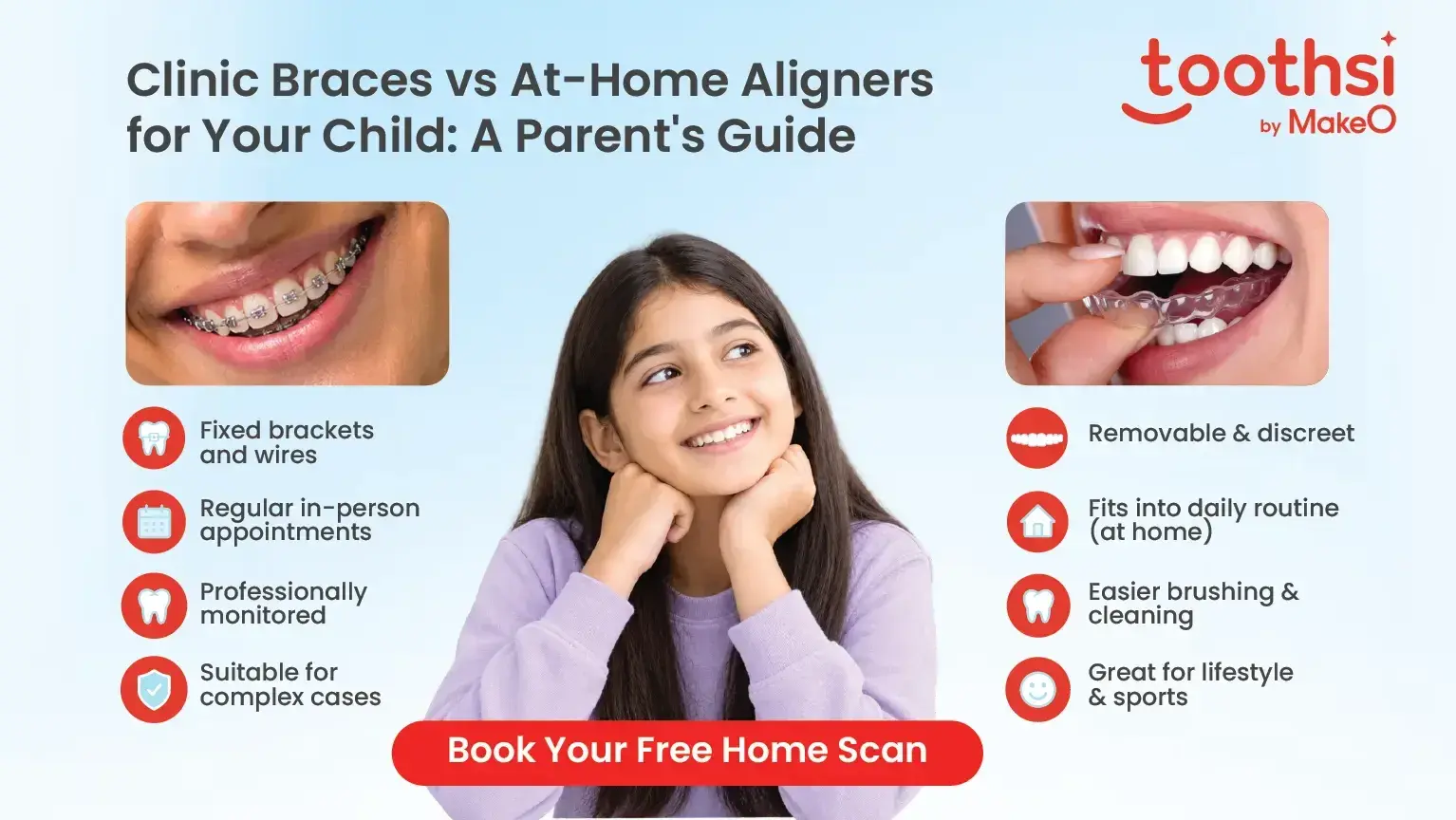
Clinic Braces vs At-Home Aligners for Your Child: A Parent’s Guide

MDS - Orthodontics, the Co-Founder & CEO of MakeO Toothsi. A certified lingual orthodontist with 15 years overall experience. Updated on August 14, 2026
Updated on September 23, 2026
Choosing orthodontic treatment for your child involves more than deciding how to straighten their teeth. Parents need to consider everyday factors such as eating, brushing, school, sports and how well their child can follow a treatment routine.
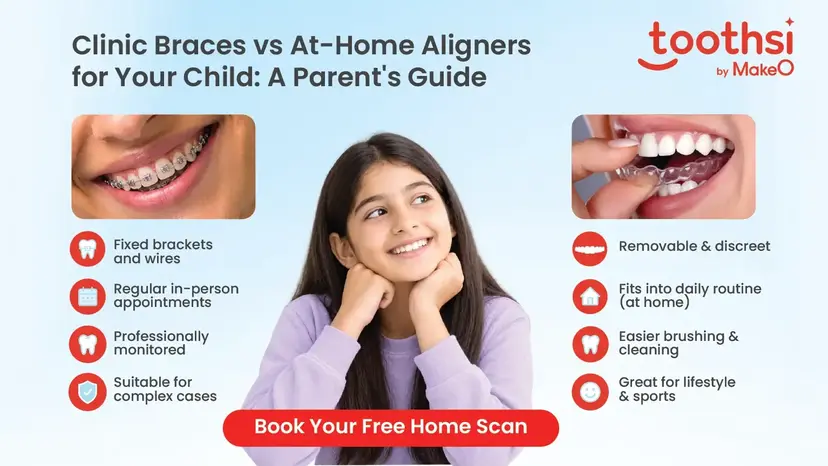
At-home clear aligners offer a removable and discreet option, while in-clinic braces for child treatment use fixed brackets and wires with regular in-person appointments. Both dental treatment options can be professionally supervised when planned around a child’s individual orthodontic needs.
Toothsi offers both at-home clear aligners for teens and In clinic braces, with dental professionals assessing the case and recommending a suitable treatment approach. This guide compares the two options to help parents understand what each involves and what to consider before making a choice.
Book your FREE Consultation and get your personalised treatment plan
At-Home Clear Aligners vs Clinic Braces: What’s the Difference?
Both at-home clear aligners and clinic braces are designed to improve your smile. Teeth aligners and in-clinic braces move teeth into better alignment, but the treatment experience differs.
Dental braces for children are like fixed brackets and wires, while aligners use a series of removable, transparent trays.
For parents, the choice often comes down to their child’s orthodontic needs, daily routine, ability to follow treatment instructions, and the level of in-person care they require.
Read More: Parents Guide To Clear Aligners For Teens
At-home clear aligners
At-home clear aligners are transparent, removable trays that are custom-designed to gradually move the teeth according to an orthodontist-approved treatment plan.
A 3D dental scan is used to create a digital view of the teeth, which helps the orthodontist plan the required tooth movements and treatment stages.
One of the main conveniences of teeth aligners is that they can be removed for eating, brushing and other activities as advised. This can make them a practical option for older children and teenagers who are comfortable following a daily wear routine.
However, because they are removable, children need to be responsible about wearing them for the prescribed duration, storing them safely and keeping them clean.
In-clinic braces
In-clinic braces uses fixed brackets and wires that remain attached to the teeth throughout treatment.
Compared with removable aligners, the braces for children stay in place, allowing the orthodontist to make controlled adjustments at regular appointments as the teeth gradually move into their planned positions.
For parents considering in-clinic braces for their child's treatment, one practical advantage is that the child does not have to remember to put the appliance back after meals or activities. However, braces require careful brushing around the brackets and wires, and children may need to avoid or modify certain hard, sticky or chewy foods to protect the appliance. Braces for teens can be considered when fixed treatment is more appropriate for their dental alignment or when consistently wearing a removable appliance may be difficult. The final choice should be based on an orthodontic assessment rather than age or appearance alone.
What Is Everyday Life With Braces vs Aligners?
For parents, choosing the right orthodontic treatment approach is also about understanding how it fits into a child’s everyday routine. Eating, brushing, school activities, and keeping up with treatment instructions can all feel different with braces compared with removable aligners.
Eating With Braces
For children wearing braces, meal times may require a few changes to protect the brackets and wires:
- Avoid hard and sticky foods: Hard sweets, chewing gum, caramel and similar foods can damage or get stuck around the braces.
- Cut food into smaller pieces: Foods such as apples, firm fruits and vegetables can be cut into bite-sized pieces instead of biting into them directly.
- Chew carefully: Children may need to take smaller bites and chew gently to avoid putting excessive pressure on brackets and wires.
- Watch for food getting trapped: Food particles can collect around brackets and between wires, making thorough brushing especially important.
- Limit certain snacks: Hard, crunchy or sticky snacks may need to be reduced or avoided during treatment.
- Follow the orthodontist’s food advice: The exact restrictions can vary, so children should follow the eating and care instructions given for their braces for children treatment.
Eating With At-Home Clear Aligners
One of the everyday conveniences with teeth aligners is that they are removable. Which means,
- Remove before meals: Aligners can be removed before eating.
- Fewer food restrictions: Since there are no brackets or wires to work around while eating, children generally do not need to make the same food-related adjustments as they would with fixed braces.
- Suitable for responsible children: Clear aligners for children can offer greater mealtime flexibility, while aligners for teens can be convenient for school, social activities, and eating.
Brushing and Cleaning
Keeping teeth and orthodontic appliances clean is important throughout treatment. The daily routine differs between clinic braces for child treatment and removable at home clear aligners:
With braces:
- Brush around brackets and wires: Children need to brush carefully around each bracket and along the wires to remove plaque and food particles.
- Pay attention to trapped food: Food can collect between brackets and around wires, so regular and thorough cleaning is important.
- Maintain consistency: Good oral hygiene is especially important for teens.
With aligners:
- Aligners are removed for oral hygiene
- Teeth can be brushed normally before putting the trays back in
- The aligners themselves also need to be cleaned according to instructions
What About School, Sports and Your Child’s Routine?

For parents, the main concern is to understand how orthodontic treatment will fit into a child’s routine. School, sports, and other daily activities can affect how comfortable and manageable braces or teeth aligners feel.
School and Social Activities
- Braces remain visible throughout the day, while clear aligners are transparent and less noticeable. This may matter for teenagers who are conscious of their appearance.
- With braces, children need to avoid foods that could damage brackets or wires. With removable aligners, they can take the trays out before eating as instructed.
- Whether using braces for children or clear aligners for children, maintaining good oral hygiene at school and after meals is important.
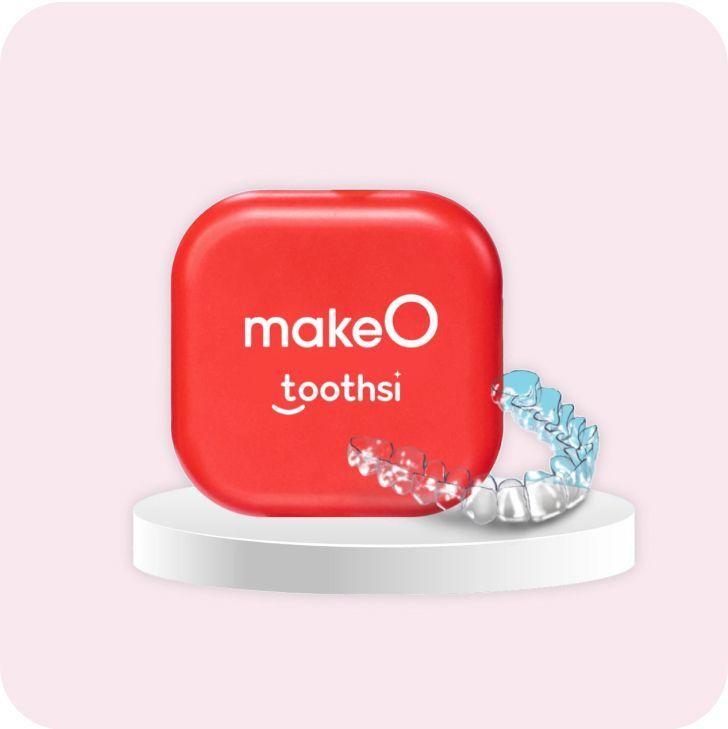
- Parents choosing at home clear aligners for their child should make sure they are comfortable removing, storing and putting the aligner box away. An aligner box can help prevent them from being misplaced during school hours.
- For teens, the removable, discreet design can make aligners easier to incorporate into school and social activities, as long as they follow the prescribed wear routine.
Sports and Physical Activities
- Children participating in sports may need additional protection for their teeth and braces. As a parent, you must ask the orthodontist about suitable protective equipment.
- Depending on the sport and treatment instructions, teeth teen aligners may be removed when required.
Which Option Requires More Daily Responsibility?
Both at-home clear aligners and in-clinic braces for children requires your child to follow a daily care routine. The type of responsibility is simply different.
With teeth aligners:
- Remember to wear them: Your child needs to wear the teeth aligners for child for the prescribed duration each day, which is 20 to 22 hours.
- Remove them correctly: Remove the aligners for meals and as advised by the orthodontist.
- Store them safely: When not in use, the aligners should be kept in their protective box to avoid loss or damage.
- Keep them clean: Both the aligners and teeth need to be cleaned as instructed before the trays are worn again.
- Stay consistent: Because clear aligners for children are removable, parents may need to remind younger children to put them back after meals.
With braces:
- Care for the brackets and wires: The fixed appliance stays on the teeth, so children need to brush carefully around it.
- Maintain oral hygiene: Regular and thorough cleaning is important because food can collect around brackets and wires.
- Attend scheduled appointments: Regular visits allow the orthodontist to monitor progress and make necessary adjustments.
Aligners for teens are removable and offer flexibility during meals and social activities, but teenagers must be responsible about wearing and caring for them.
Similarly, braces for children and braces for teen treatment require children to take care of their appliance and maintain good oral hygiene.
The key point for parents: convenience does not mean less responsibility. Aligners shift more responsibility towards the child’s daily habits, while braces require greater care around food, cleaning and the fixed appliance.
How To Choose Between Teeth Aligners And Braces For Your Child
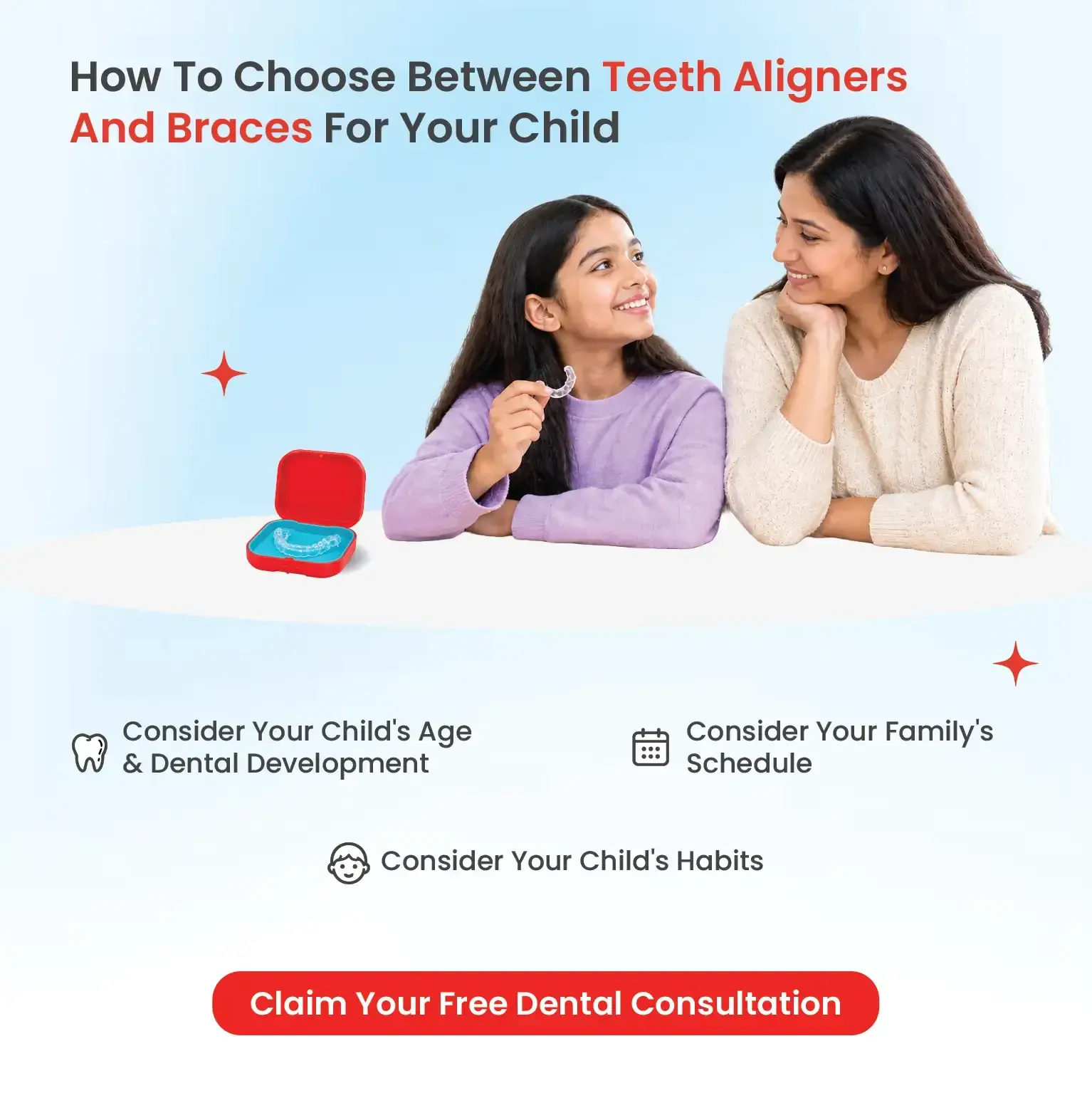
When choosing between teeth aligners and braces, parents should consider their child’s dental development, treatment needs, habits, and everyday routine. Consult an orthodontist, as an orthodontic assessment should come before deciding which appliance to use.
Consider Your Child’s Age and Dental Development
Children’s stage of dental development can influence when and how orthodontic treatment should begin. Some teenagers may be suitable for clear aligners, depending on their individual orthodontic needs and ability to follow the treatment routine. Clear aligners are suitable when the child has developed permanent teeth and his/her milk teeth have fallen out.
Consider Your Child’s Habits
Because aligners are removable, your child’s ability to follow the treatment routine matters. Before choosing at home clear aligners, ask:
- Will my child remember to wear the aligners for the prescribed duration?
- Can they keep the aligners safely in their case when removed?
- Will they maintain the required cleaning routine?
- Would my child find a fixed appliance easier to manage?
Consider Your Family’s Schedule
The treatment should also fit comfortably into your family’s routine. Consider:
- Clinic appointments: How frequently will your child need in-person visits?
- School schedule: Will appointments be easy to manage around school hours and exams?
- Travel: How convenient is it for your family to attend regular appointments?
- Follow-ups: Would your family prefer regular in-person appointments or a treatment plan that includes supported remote follow-ups where appropriate?
Ultimately, the choice between teeth aligners and braces should be based on your child’s orthodontic needs as well as their ability to manage the treatment. A professional assessment can help parents understand which option is suitable before making a decision.
When Should Parents Consider Braces or Clear Aligners for Their Child?
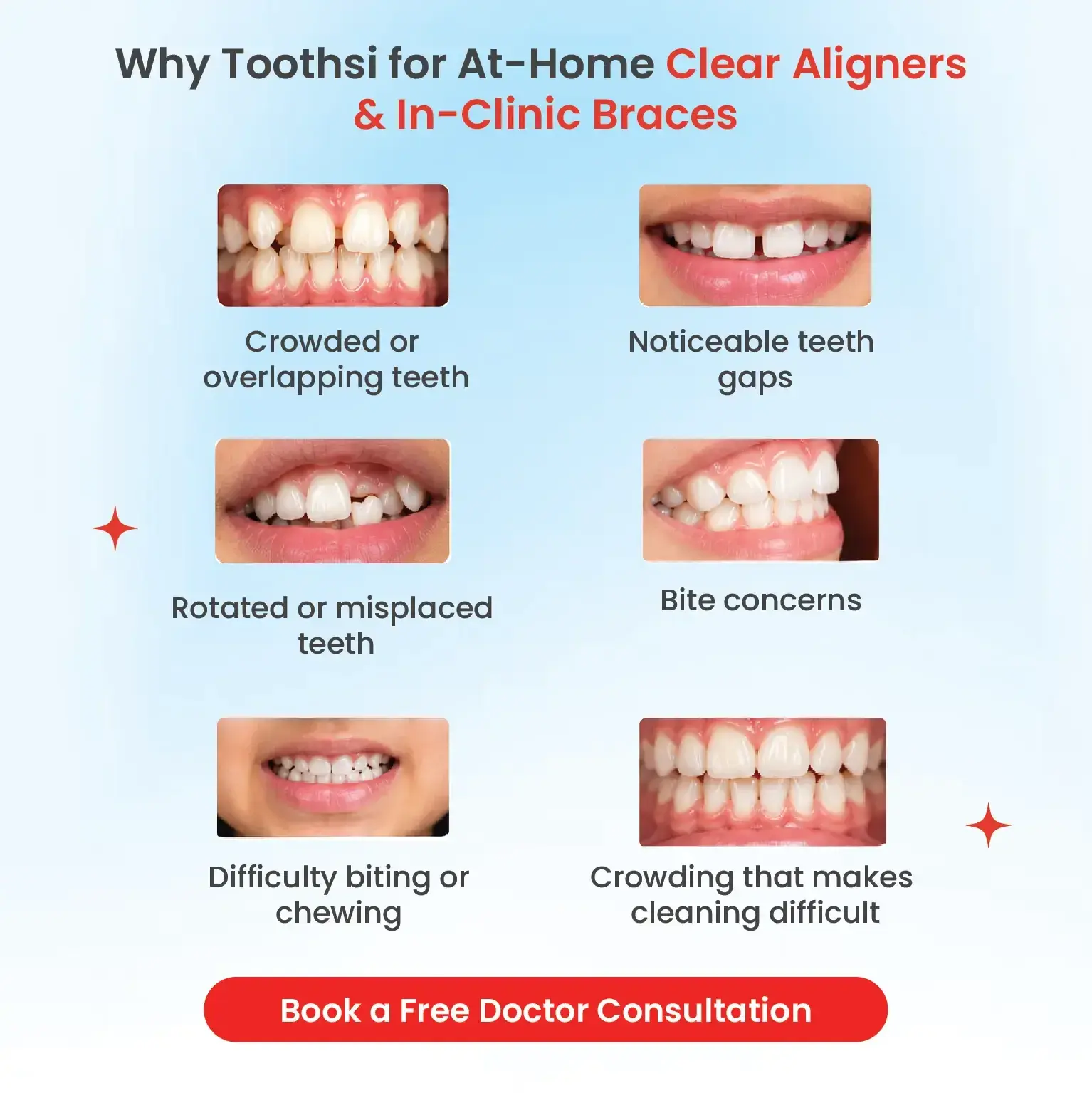
- Crowded or overlapping teeth: Teeth may appear tightly packed or difficult to clean properly.
- Noticeable teeth gaps: Spaces between teeth may be a sign that an orthodontic evaluation is needed.
- Rotated or misplaced teeth: Some teeth may appear twisted, tilted or positioned differently from the surrounding teeth, such as a forwardly placed teeth.
- Bite concerns: An overbite, underbite, deep bite, or crossbite can affect how the upper and lower teeth meet.
- Difficulty biting or chewing: Problems with biting or chewing comfortably may warrant an orthodontic check-up.
- Crowding that makes cleaning difficult: Overlapping or tightly positioned teeth can make it harder for children to brush and clean between their teeth effectively.
These signs do not automatically mean your child needs braces or clear aligners for children. The appropriate treatment depends on their dental development, bite, and individual orthodontic needs.
The earlier question to ask is not “Which treatment should my child get?” but “Does my child need an orthodontic assessment?”
Why Toothsi for At-Home Clear Aligners and In-Clinic Braces
Toothsi offers both at-home clear aligners and in-clinic braces, giving parents the flexibility to consider different treatment options while keeping professional dental care at the centre of the journey.
- Orthodontist-supervised treatment: Your child’s treatment is planned and monitored by professional orthodontists
- Both aligners and braces: Toothsi offers teeth aligners for child and teen patients, as well as metal and ceramic braces for teens.
- Personalised treatment planning: We conduct a 3D dental scan and professional assessment to help determine the appropriate treatment approach rather than choosing an appliance based only on appearance or convenience.
- Convenient aligner treatment: For suitable cases, clear aligners for children and aligners for teens offer a removable and discreet option that can fit into everyday routines.
- In-clinic care when needed: Children undergoing in-clinic braces treatment can have their braces monitored and adjusted through scheduled in-person appointments.
- Support throughout treatment: Whether your child is using teeth aligners or braces, progress is monitored throughout the treatment journey, with follow-ups based on the treatment plan.
- Treatment based on suitability: Toothsi does not require every child to follow the same treatment route. The appropriate option depends on the child's dental development, alignment concerns, bite and ability to manage the appliance.
For parents comparing at home clear aligners with braces for children or braces for teen, Toothsi provides both options under one orthodontic care model. A consultation can help you decide which approach is right for your child before you decide.
Cost of At-Home Clear Aligners and In-Clinic Braces?
The cost of teeth aligners at Toothsi starts from ₹42,999 with the student discount. Cost Of Braces start at ₹35,000 for metal braces and ₹40,000 for ceramic braces. The final treatment recommendation and applicable cost can vary based on the individual case.
Check Out Braces Price In India
Book your FREE consultation with Toothsi to understand your child’s orthodontic needs and discuss the treatment options available.