

Can Teenagers Get Braces? A Complete Guide to Teenage Orthodontic Treatment

MDS - Orthodontics, the Co-Founder & CEO of MakeO Toothsi. A certified lingual orthodontist with 15 years overall experience.
Updated on November 13, 2026
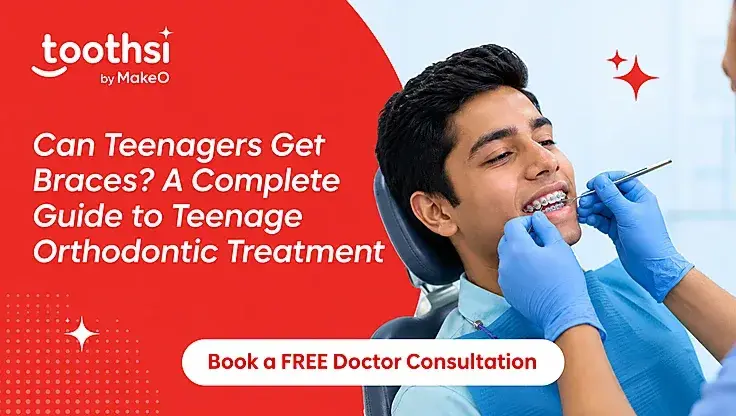
Can Teenagers Get Braces?
Yes, teenagers can get braces. In fact, adolescence is one of the most common stages for orthodontic treatment because most permanent teeth have erupted, while the jaws may still be developing.
Orthodontic treatment during the teenage years can address several dental concerns, including crowded teeth, gaps, protruding teeth and bite irregularities. Correcting these issues can improve dental alignment, support proper biting and chewing, and make oral hygiene easier.
An orthodontist can assess these factors and determine whether treatment should begin immediately or whether periodic monitoring would be more appropriate.
What Is the Ideal Age for Teenagers to Get Braces?
There is no single ideal age for every teenager to get braces. However, comprehensive orthodontic treatment commonly begins between 11 and 14 years of age.
By this stage, most permanent teeth have erupted, making it easier for an orthodontist to evaluate the overall bite and identify alignment problems.
The American Association of Orthodontists recommends that children have their first orthodontic evaluation by age seven. This does not mean that every child needs braces at seven. Early assessment helps identify developing problems that may benefit from timely intervention or monitoring.
For teenagers, the timing of treatment depends on several factors:
Permanent teeth eruption: Most permanent teeth should have erupted before comprehensive treatment begins, although certain cases may require earlier intervention.
Jaw development: Some bite-related problems are easier to manage while the jaws are still growing.
Severity of misalignment: Significant crowding, protrusion or bite irregularities may require earlier assessment.
Dental health: Healthy gums, teeth and supporting structures are important for safe orthodontic treatment.
Starting treatment at the appropriate stage can help an orthodontist plan tooth movements more effectively.
What Signs Indicate That a Teenager May Need Braces?
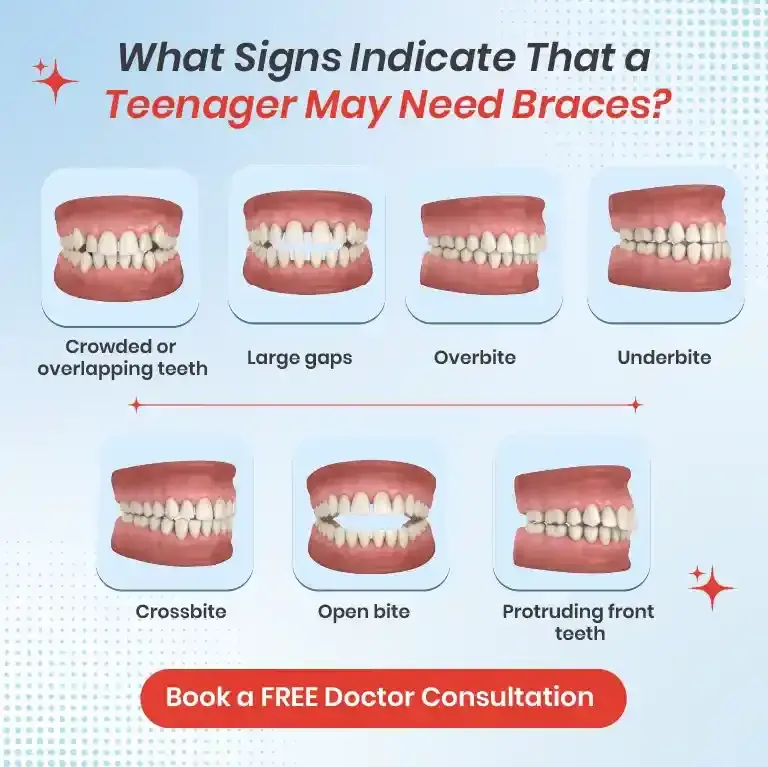
Parents may not always recognise orthodontic problems, particularly when the teeth appear relatively straight. However, certain signs may indicate that a teenager needs an orthodontic evaluation.
These include:
Crowded or overlapping teeth: Permanent teeth may not have sufficient space to erupt or align properly.
Large gaps between teeth: Excessive spacing may affect tooth positioning and bite alignment.
Overbite: The upper front teeth overlap the lower front teeth excessively.
Underbite: The lower front teeth sit ahead of the upper front teeth when the jaws are closed.
Crossbite: One or more upper teeth bite inside the corresponding lower teeth.
Open bite: The upper and lower front teeth do not meet when the back teeth are together.
Protruding front teeth: Forwardly positioned upper teeth may be more vulnerable to injury during sports or accidental falls.
If any of these concerns are present, an orthodontic assessment can help identify the underlying problem and determine whether treatment is necessary.
What Types of Braces Are Available for Teenagers?
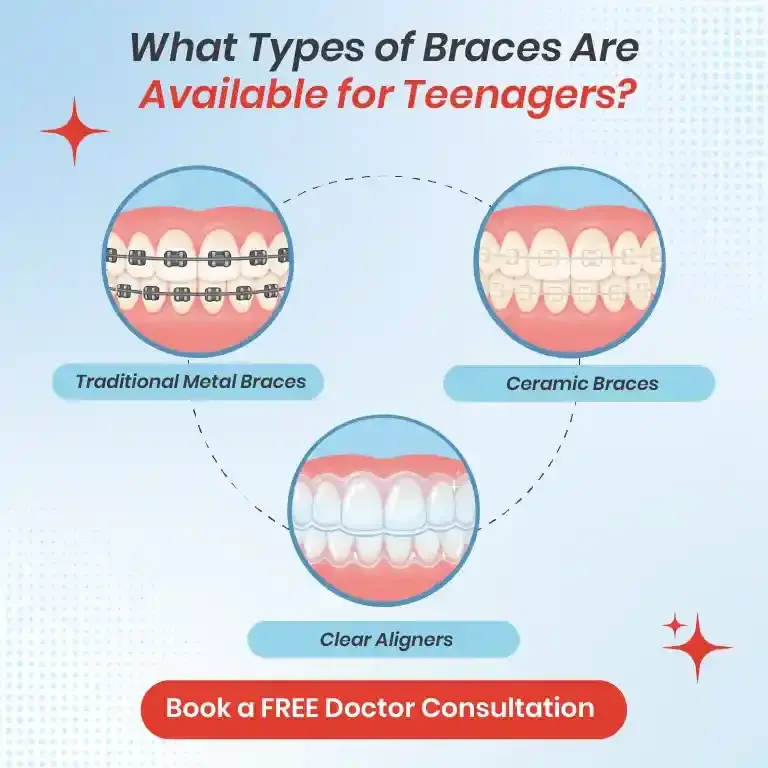
Teenagers today have several orthodontic treatment options. The choice depends on the type of misalignment, dental development, treatment complexity and the teenager's ability to follow treatment instructions.
1. Traditional Metal Braces
Metal braces use brackets attached to the teeth and connected through orthodontic wires. The wires apply controlled pressure to gradually move teeth into their planned positions.
They are suitable for a wide range of orthodontic conditions, including complex alignment and bite problems. However, their visibility and dietary restrictions may be concerns for teenagers.
2. Ceramic Braces
Ceramic braces work similarly to metal braces but use tooth-coloured brackets that are less noticeable.
They are an option for teenagers who prefer a more discreet fixed appliance. However, they require careful maintenance, as the brackets may stain or break.
3. Clear Aligners
Clear aligners are removable, transparent trays customised to fit the patient's teeth. Each set is designed to produce specific tooth movements as treatment progresses.
They offer certain practical advantages for teenagers:
They can be removed while eating and brushing.
They are less noticeable than conventional metal braces.
They allow easier access to teeth during brushing and flossing.
They can be more convenient for teenagers involved in sports and other activities.
Toothsi offers customised clear aligner treatment using digital 3D scans and professionally supervised treatment planning. Its treatment process includes a free consultation and 3D scan, which can be arranged at home or at an experience center.
For eligible teenagers, Toothsi provides an alternative to conventional braces without compromising the importance of professional assessment and monitoring.
However, aligners need to be worn for approximately 20–22 hours daily, and patients must follow the prescribed schedule for changing trays.
Explore Toothsi Aligners for Teens
Are Clear Aligners Suitable for All Teenagers?

Clear aligners can address several orthodontic concerns, but their suitability depends on the teenager's dental development and the complexity of the case.
An orthodontist needs to assess whether the permanent teeth have erupted sufficiently, whether the bite requires correction and whether the planned tooth movements can be achieved with aligners.
Other important considerations include:
The presence of retained baby teeth.
The eruption pattern of permanent teeth.
Jaw growth and skeletal discrepancies.
The severity of crowding or spacing.
The teenager's ability to maintain consistent aligner wear.
Toothsi provides customised aligner treatment for eligible teenagers and offers orthodontic assessment to determine an appropriate treatment approach. The final recommendation should always be based on clinical findings rather than age or appearance alone.
How Long Does Braces Treatment Take for Teenagers?
The duration of orthodontic treatment depends on the severity of misalignment, the type of appliance used and the teenager's response to treatment.
In general, comprehensive orthodontic treatment may take approximately 12–24 months. Mild alignment concerns may require less time, while complex bite corrections can take longer.
With clear aligners, treatment progress also depends on wearing the trays for the prescribed number of hours every day. Missing wear time or frequently skipping aligner changes can delay results.
After treatment, retainers are prescribed to help maintain the corrected tooth positions. This is an important part of orthodontic care, as teeth can naturally shift over time.
How Can Parents Help Teenagers During Orthodontic Treatment?
Parental involvement plays an important role in successful orthodontic treatment, particularly when teenagers use removable aligners.
Parents can support the process by:
Ensuring regular dental appointments and orthodontic follow-ups.
Encouraging proper brushing and flossing.
Monitoring aligner wear time and tray changes.
Following dietary and appliance-care instructions.
Ensuring retainers are worn as prescribed after treatment.
A teenager's cooperation is particularly important with removable appliances. Consistency and regular professional monitoring help keep treatment on track.
Final Thoughts
Teenage years are often an appropriate time to address orthodontic concerns because permanent teeth have largely erupted and the jaws may still be developing. However, the right time to begin treatment varies from one individual to another.
Whether a teenager needs traditional braces, ceramic braces or clear aligners depends on their dental development, bite and treatment requirements.
Toothsi offers customised clear aligner treatment for eligible teenagers, combining digital scanning, personalised treatment planning and professional supervision. The first step is a clinical assessment to determine the most suitable treatment approach.