
- ToothsiSmile CorrectionBrighter smilenewToothsi Productsnew
- Skin & HairLaser hair removalnewestAdvance skin treatmentfacials



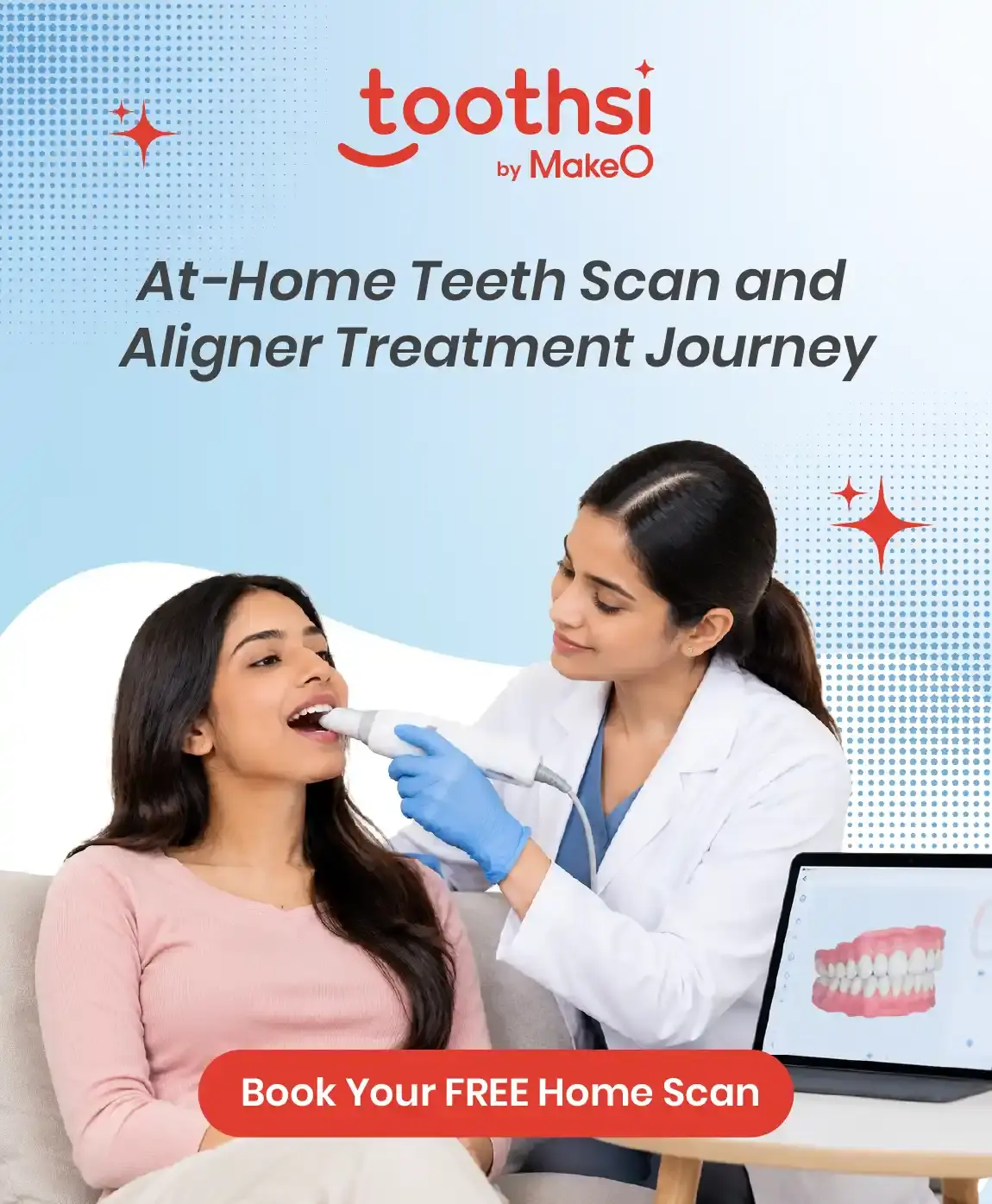
At-Home Teeth Scan and Aligner Treatment Journey
Toothsi is the dental brand of MakeO Healthcare Technologies Limited, started in 2018 by four orthodontists. This page is for anyone weighing an at-home teeth scan against a clinic visit and wondering what really happens between the booking and the day the first aligners arrive. You get an orthodontist-planned treatment, whether the scan is taken in your living room or at an experience centre.
A home scan is not a shortcut around clinical judgement. It is a way to capture your teeth accurately so a qualified orthodontist can assess your case and design a plan. The scan is the start of the process, not the whole of it.
What the at-home scan and treatment journey actually is
The at-home journey lets you begin orthodontic treatment without a first trip to a clinic. A trained technician visits you, captures a digital record of your teeth, and that record goes to an orthodontist for assessment. If aligners suit your case, you receive a personalised sequence of trays and track progress through the app, with clinical support along the way.
The point is access. toothsi reports a network that reaches more than 210 Indian cities, backed by over 110 experience centres and a wide partner-clinic network (see why toothsi). A home scan extends that reach to your door, then keeps the orthodontist in charge of the actual treatment decisions.
How a home scan works, step by step
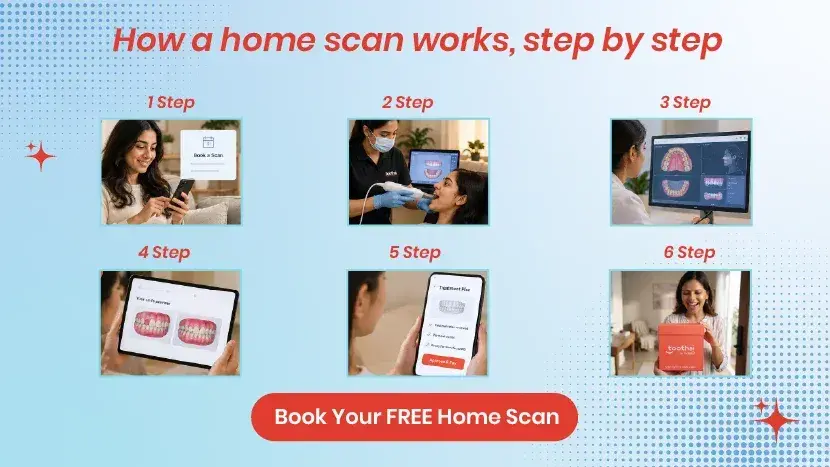
- Book a scan slot online for your home, a clinic, or a nearby experience centre.
- A trained technician arrives with a portable scanner and captures a full digital record of your upper and lower teeth.
- The scan is uploaded and reviewed by an orthodontist, who checks tooth position, spacing, crowding, and how the bite meets.
- You receive a digital smile preview that shows the likely movement plan.
- You approve the plan and a payment option before anything is manufactured.
- Your aligners are produced and delivered, and you begin wearing the first set.
Each step has a person accountable for it. The scan is captured by a technician, but the treatment plan is owned by a clinician
Home scan vs in-clinic 3D scan: how accurate is each?
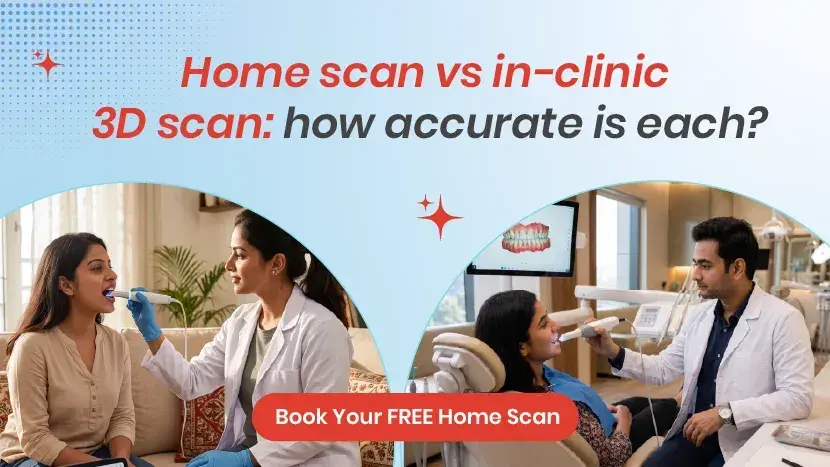
A digital home scan and an in-clinic 3D scan use the same idea: an optical capture of your teeth rather than a tray of putty. The question people ask is whether the home version is accurate enough to plan real tooth movement.
The evidence on digital capture is reassuring. A 2022 systematic review and meta-analysis of digital versus conventional full-arch impressions found that digital scanning performs comparably to conventional impressions for accuracy across in vivo studies. A well-taken digital scan gives an orthodontist a dependable model to plan from. What a home setting adds is convenience, not a drop in the quality of the record, provided the technician captures a clean, complete scan.
What the orthodontist reviews after your scan
Once your scan is in, an orthodontist studies more than the crookedness you can see in the mirror. They look at how the upper and lower arches meet, whether there is crowding or spacing, the type of bite, and whether the gums look healthy enough to move teeth safely, and they decide whether X-rays are needed to check the roots. This is also where a case is graded as simple, moderate, or one that may need braces or a combined approach.
That review is the reason a scan alone is never a promise. It is the input a clinician needs to say yes, no, or not yet.
Seeing your digital smile preview before you pay
You can see a digital preview of the planned outcome before committing to the full treatment cost. The preview shows how your teeth are expected to move across the plan, which makes the decision concrete rather than abstract. You approve the plan and the commercial terms first, then manufacturing begins. Nobody asks you to pay for a full aligner sequence sight unseen.
What happens between booking and your first aligners
People underestimate how much sits between a booking and a delivery. After the scan, the orthodontist assessment and plan design take time because a clinician designs each plan individually. Once you approve, the aligners are manufactured to your specific sequence and then shipped. The gap is short, but it exists for a good reason: every tray in the set is cut for your teeth and no one else's.
A realistic treatment timeline
Treatment length depends on complexity, the movement plan, and how consistently you wear the aligners. toothsi's own published cases show the spread clearly. A simple spacing case ran about four months across 14 aligners, while a moderate crowding case ran about 13 months across 42 aligners. Those are individual results, not a quote for your mouth, but they show why an honest provider gives you a range only after the scan review, not before.
Wearing and tracking your aligners through the app
You wear each set as prescribed, then move to the next in the sequence. Progress is tracked through the toothsi app, which supports remote check-ins so the clinical team can watch how your teeth respond. If something looks off, the plan can be adjusted. Remote monitoring reduces routine clinic trips, but it does not remove the clinician from your care.
When a home scan is not enough
Here is the honest limit. A home scan cannot fully stand in for an in-person examination when a case is complex, when there is active gum disease, loose teeth, or untreated cavities, or when the bite problem is severe. In those situations the orthodontist may ask you to come in, or may recommend braces or a combined plan instead of aligners. That is a feature of careful treatment, not a failure of the scan.
Who the at-home journey suits
The home route works well for adults and teens with mild to moderate concerns, such as spacing or crowding, who want a discreet, removable option and can commit to the prescribed wear time. Adults can read more about clear aligners for adults, and parents can see the guide to clear aligners for teens. It also suits people with travel-heavy schedules who cannot make frequent clinic visits, because so much of the follow-up is app-supported.
Who should start at a clinic instead
If you have pain, active dental disease, or a bite that already looks complicated, start with an in-person consultation; you can contact the toothsi team to arrange one. The same is true if you have had aligners or braces before that did not fit or track well; a fresh clinical exam protects you from repeating a mismanaged case.
What happens if your scan is unclear or incomplete
A scan can come back incomplete if a region was missed or the capture was blurred. When that happens, the process pauses rather than pushing ahead on bad data. You are asked for a re-scan or a short clinic visit to capture the missing detail. Nothing is manufactured from a record the orthodontist cannot trust, so an unclear scan costs you time, not a wasted aligner set.
Costs and payment, without the guesswork
Cost depends on case complexity and the specific plan the orthodontist designs, so a single sticker price online can mislead. Start with the toothsi pricing page, then ask for the current approved quotation, confirm what it includes, and check the aftercare terms. toothsi shows financing and EMI options on its site, which lets many people spread the cost rather than pay upfront. Treat any old web price as a rough guide only, never as your quote.
Retainers and life after treatment
Straightening is not the finish line. After active treatment, retainers are commonly prescribed to hold your teeth in their new position, because teeth naturally drift over time. Plan for retainers from the start, and treat them as part of the result rather than an add-on.
How to judge a home-scan aligner provider
Look for four things:
- An orthodontist, not just a sales team, owns the plan.
- You see a digital preview and a written quote before you pay.
- The provider supports remote monitoring with real clinical check-ins.
- There is a clear path to in-person care if your case needs it.
If a provider is missing any of these, treat that as a warning.
Real toothsi treatment journeys
Toothsi publishes named customer cases that show the range of the at-home planned journey. Shubham's spacing case was graded simple and completed in about four months across 14 aligners. Vamshi's forwardly placed front teeth were graded moderate and planned across 26 aligners over about eight months. These are the provider's published examples, and every one carries the same caveat: an orthodontist must assess your case before any timeline applies to you.
Frequently asked questions
How accurate is an at-home teeth scan compared with an in-clinic 3D scan?
A well-taken digital home scan gives an orthodontist a dependable model to plan tooth movement. Published research comparing digital and conventional full-arch impressions finds digital capture performs comparably on accuracy. The setting matters less than the quality of the scan, so the technician's job is to capture a clean, complete record.
What exactly happens between booking a home scan and receiving my first aligners?
After the scan, an orthodontist reviews your teeth and designs a movement plan, which takes time because a clinician designs each plan individually. You then see a digital preview, approve the plan and a payment option, and only then are your aligners manufactured to your sequence and delivered. The wait exists because every tray is cut for your teeth alone.
Can I see and approve a digital smile preview before I pay for treatment?
Yes. You can view a digital preview of the planned outcome before committing to the full cost. The preview shows how your teeth are expected to move across the plan. You approve both the clinical plan and the commercial terms first, then manufacturing begins, so you are never asked to pay for an aligner set you have not seen planned.
Is a home scan reliable enough for a complex bite case?
Not on its own. A home scan captures an accurate record, but a complex bite, active gum disease, or severe crowding usually needs an in-person examination. In those cases the orthodontist may ask you to visit a clinic, or may recommend braces or a combined approach rather than aligners. The scan informs that decision; it does not replace the clinical exam.
What happens if my at-home scan comes back unclear or incomplete?
The process pauses. Nothing is manufactured from a record the orthodontist cannot fully read. You are asked for a quick re-scan or a short clinic visit to capture the missing detail. An unclear scan costs you a little time rather than a wasted aligner set, because the plan is only built once the clinical record is trustworthy.
Can the whole aligner treatment be managed remotely if I travel a lot?
Much of it can. The scan can be taken at home, the plan is designed by an orthodontist, and progress is tracked through the app with remote check-ins, which suits people who cannot make frequent clinic trips. In-person care may still be needed at certain points, depending on how your case responds, so remote monitoring supports the clinician rather than removing them.
How long does aligner treatment usually take after a home scan?
It varies with case complexity, the movement plan, and how consistently you wear the trays. toothsi's published cases range from about four months for a simple spacing case to around 13 months for a moderate crowding case. Your own range comes from the orthodontist only after the scan is reviewed, not from a general figure online.